Westchester Trails Association
  • Home
  • About WTA
  • Our History
  • Hikes
  • News & Notices
  • Join/Contact
  • More
    • Home
    • About WTA
    • Our History
    • Hikes
    • News & Notices
    • Join/Contact
Westchester Trails Association
  • Home
  • About WTA
  • Our History
  • Hikes
  • News & Notices
  • Join/Contact

WESTCHESTER TRAILS ASSOCIATION  was originally formed in September of 1923 by the County of Westchester under a resolution and charter adopted to “promote appreciation for the natural beauty of Westchester County, secure trails for those who ride horseback, improve the old foot and bridle paths, publish information for the benefit of the public in regard to all trail facilities, and assist the Director of Recreation in training hike leaders”.

The club’s first president was Col. Charles Francis Bates, an author and retired U.S. Army officer. Included among WTA’s early hike leaders was Raymond Torrey, co-author of the original New York Walk Book and one of the founders of the New York New Jersey Trail Conference, for whom the Torrey Memorial was dedicated atop Long Mountain in Harriman State Park. Another popular leader was the club’s second president, Charles B. Reid - while hikers of that era preferred to carry a large coffee pot and a pound of coffee to make a hot drink for lunch, Mr. Reid was known for “properly preparing hot tea for the group.”


Hikers were fashionable and practical in 1925 when these pictures were taken. Men wore knickers while women were starting to switch from the long skirts that had been common in earlier decades to knickers or jodhpurs (club schedules flatly stated that "women should not wear skirts on the trail"). Schedules advised hikers to "bring lunch and a canteen or thermos as drinking water is not readily available. The most comfortable way to carry these, plus extra clothing, etc., is in a knapsack, although a shoulder bag will do." "Strong shoes with broad flat heels are a must...Carry some sort of rain gear if the weather is at all threatening. There is seldom any shelter on hikes, even at lunch time. Take an extra sweater and socks. It may be colder than you expect. Outings will not be postponed on account of inclement weather."

Outings Schedules  featured hikes to some of the places that we still visit today. Here are excerpts from a few entries in the 1933 Spring and Summer Schedule:


Sunday, February 26 - Appalachian Trail. The Association will clear a small section of the Appalachian Trail south of Clear Lake. Bring hatchet.


Saturday, March 18 - Ardsley-on-Putnam. Follow foot paths along the new Saw Mill River Parkway and roads to Ardsley Heights. A 5 mile walk, not strenuous.


Week-End March 25-26 - Taconic Park Reservation and Bash Bish Falls. Trip to Copake Falls leaving Saturday afternoon, arriving Taconic Park in evening, stay overnight in cabins, hike Sunday morning and return Sunday afternoon. A stop may be made if desired at Drover’s Inn, Dover Plains for dinner. Dinner $1.50, very good.


Sunday, May 7 - Mount Taurus. Good woods roads and easy climbing to summit of Mt. Taurus, glorious views of Hudson River and surrounding country. Camp fire, bring lunch cup and spoon. Distance about 10 miles.


Saturday, June 10 - Need We Fear Snakes? Details to be announced later.

Atop Claudius Smith's Den, 1939

A hiker's unique perspective of Ward Pound Ridge Reservation, 1940

Larchmont Reservoir, date unknown

In December 1941 the United States entered World War II. Membership in the club declined due to wartime service, available leaders were reluctant to volunteer because of low turnout on the hikes, and WTA came close to being disbanded. A 1943 schedule referenced shortages caused by the war, and urged members to take turns using their cars “so that we have enough gasoline for some of our favorite trips”. By October of 1947 WTA’s president William H. Knapp warned that the organization had reached a point where it might not continue beyond the current year, and he sent out a questionnaire asking for suggestions as to how to turn the tide on WTA’s declining fortunes. Most responses naturally dealt with “getting the word out” through publicity, talking up the club to friends, and otherwise promoting the organization’s activities. One member, though, focused on building support from within. He advocated “...more respect for the old, for the oddities, for families...for those we do not know. There must be a backbone of regulars, that is, folks who love to hike and who come out regularly. ... [And] the president ought to hike with the club about 90% of  the time!”


Whether due to member  recommendations, hard work or the happenstance of an improving postwar economy, the club persevered and its membership grew. An Outings Committee Report from 1952/53 exemplified the dedication of WTA’s core group of hikers:


“This year we had 25 hikes, 2 weekend trips (one to the Catskills and one to the Delaware Water Gap), a boat ride across Long Island Sound, a canoe outing on Lake Waccabuc, swimming at Sherwood Island, and a Christmas Party with Sound Film Exhibits plus coffee and delicious confectionery. The unusually frequent rainfalls cut down the attendance on hikes. Yet ...I partook in three hikes on days where the weather outlook was bad and each time about a dozen hikers showed up and suffered the drenching goodhumoredly.”

Did you know that WTA has its own song? With lyrics written in 1951 by club member Phyllis Willliams Belletta and sung to the tune of Aura Lee, it predates Elvis Presley’s  “Love Me Tender,” which borrows from the same melody:


♪ ♬  When the leaves have turned to gold and frost is in the air, 

Once again we’re off on foot, a-hiking everywhere.

Tally Ho, off we go, over hills and dales,

Faithful now and ever more, to you Westchester Trails!

Thru the winter rain and snow, until the end of spring,

Still the trails we follow true, and this song we sing:

Tally Ho, off we go, over hills and dales,

Faithful now and ever more, to you Westchester Trails!

In 1961 WTA separated from the County and become an independent organization, actively continuing its involvement in the hiking and trail maintaining communities. According to the book Harriman Trails by Bill Myles (© New York New Jersey Trail Conference, 1st Edition 1992) our members were the first to come up with the concept of using double offset blazes to indicate a turn - a method later adopted as the standard of trail blazing in the area. This happened during the construction of the Beech Trail in Harriman State Park in 1972. The trail was named in honor of Art Beach, a club member who was also the Trail Conference’s representative to the Palisades Interstate Park Commission. At Art’s insistence the spelling was changed to the name of the tree, and it continues to be known that way in all trail publications. 

Not all innovations caught on. During the 1970's the club’s patch and logo, formerly a stylized “WTA” within a diamond in use since 1923, was replaced with the outdoor theme in this photo. But the logo was soon abandoned and the diamond design reinstated after some WTA members began referring to the stream in the foreground as a “river of blood through the snowfields”.

The 1980's saw a substantial increase in activity and in 1984 WTA's membership was at an all-time high. But by the mid 1990's the types of hikes offered by the club began to change. Long time leaders who could no longer do 10 miles a day in Harriman started organizing easier outings, yet new leaders were not taking their place. The club’s core values of being a social, caring and cohesive group who loved the outdoors never wavered, but the lack of variety in the schedules made it difficult to attract new members. Over the next decade our membership declined, hitting a new low in 2008. We were not alone in experiencing a loss of members during this time - it was a familiar pattern of surges and declines seen by many clubs. Still, we were determined to turn things around based on a simple formula:  more leaders = more hikes = more variety = more members.


So, in 2009-2010, WTA took several steps to change the club’s trajectory. First, we partnered with the then-active Mohican Chapter of the Adirondack Mountain Club and initiated a series of joint hikes to expand the options offered to members of both clubs. This cooperative venture worked well, allowing us to offer “something for everyone” and expand our schedule to two hikes on most weekend days.

We also began our Westchester 100 project. Inspired by the “Walkable Westchester” books written by Jane and Walt Daniels, we compiled a list of 91 “regular” hikes and 18 ”half hikes” throughout the county, challenged people to complete the list, and bestowed upon finishers a certificate, a patch, and unlimited bragging rights. To learn more about the project, click here.


Finally, we expanded our custom of taking trips to a more distant location, substituting Hiking Weeks for the long weekends that had been done before. These trips, to the Berkshires, the Catskills, the Adirondacks, Shenandoah, Acadia, and Harpers Ferry National Park and the White Mountain National Forest, among other places, are now a club tradition.


And it's not just about the hiking on these trips:

We enjoyed late afternoon gatherings near the shore of Lake Placid in the Adirondacks...

...were awed by a sunrise on Cadillac Mountain

in Acadia National Park...

... and savored the s'mores which became a  nightly tradition while visiting the White Mountains of New Hampshire.
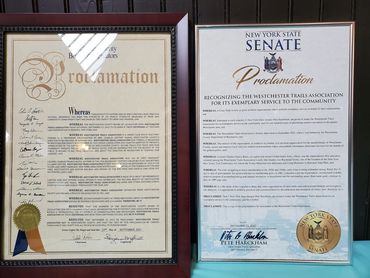
In September of 2023 WTA celebrated its 100th anniversary, and we were honored to receive Proclamations from the Westchester County Legislature and the New York State Senate recognizing our “exemplary service to the  community”.

As we continue into our second century, buoyed by the energetic assistance and ideas of our volunteer officers, board members, hike leaders, trail maintainers, committee chairs, long time members and “newbies”, WTA is moving forward, all the while pursuing its original goals of hiking and good fellowship that were established at its founding.


Copyright © 2026 Westchester Trails Association - All Rights Reserved.

This website uses cookies.

We use cookies to analyze website traffic and optimize your website experience. By accepting our use of cookies, your data will be aggregated with all other user data.

Accept